Monaco’s Philanthropic Power: From Global Development Aid to Mercy Ships
For decades, Monaco has been internationally associated with glamour, yachts, Formula 1, private banking, luxury real estate, and exceptional wealth. Yet behind this highly visible image lies another Monaco, one far less publicised, but increasingly important on the global stage.
Monaco is deeply engaged in development aid, environmental protection, climate financing, healthcare support, education initiatives and international cooperation.
According to the OECD’s 2025 donor profile, Monaco ranked among the world’s leading donor nations on a per-capita basis, confirming what many within the Principality have long understood: Monaco’s influence is not measured only by wealth, but by contribution.
This is not merely symbolic. It signals a profound transformation in how Monaco positions itself internationally: not only as a centre of prosperity, but as a strategic actor in global solidarity. And perhaps few initiatives capture this spirit more powerfully than Mercy Ships.
Historically, influence has often been associated with military strength, territory, population or economic scale. Monaco challenges this assumption entirely. Despite covering just over two square kilometres, the Principality has developed one of the most ambitious international cooperation programmes relative to its size anywhere in the world.
Between 2022 and 2024, Monaco contributed approximately €637 per inhabitant annually toward official development assistance, placing the Principality alongside countries traditionally recognised for strong humanitarian engagement, including Sweden, Norway, Denmark and Luxembourg.
For a microstate better known globally for luxury and finance, the symbolism is significant. It reflects a long-term strategic philosophy shaped under the leadership of H.S.H. Prince Albert II of Monaco: prosperity carries responsibility.
Monaco’s recognition as a leading donor nation is not the result of a short-term communications effort. It is the outcome of more than two decades of sustained work through environmental diplomacy, humanitarian engagement, scientific partnerships, targeted development aid, climate initiatives and international institutional cooperation.
Over time, the Principality has positioned itself within major global discussions surrounding sustainability, ocean preservation, biodiversity, climate finance, poverty reduction, healthcare access and education.
This gives Monaco something very unusual in modern geopolitics: soft power far exceeding its physical size. It also reveals a deeper identity, Monaco is not merely a place where wealth is concentrated. Increasingly, it is becoming a place where wealth is expected to serve purpose.
This evolution reflects a broader transformation occurring among modern ultra-high-net-worth communities globally. Historically, wealth centres often focused on capital preservation, tax optimisation, financial services and luxury consumption.
Today, expectations are changing. Affluent societies increasingly face questions around sustainability, climate responsibility, social impact, global inequality and ethical leadership. Monaco’s growing role in development aid reflects this changing global psychology.
The Principality is gradually demonstrating that financial success and international responsibility are not opposites. In fact, they may increasingly become inseparable.
Monaco’s Development Aid Is Still Growing
Perhaps one of the most striking aspects of Monaco’s international cooperation strategy is that it continues to expand.
At a time when many governments worldwide are reducing aid budgets due to geopolitical tensions, economic pressures, inflation, war-related expenditures and domestic political concerns, Monaco is moving in the opposite direction.
The Principality plans to increase development assistance by nearly 15% between 2025 and 2027, with projected aid rising from €74 million to approximately €105 million.
This reflects something strategically important: Monaco increasingly views international solidarity not as charity, but as long-term global responsibility.
One of the most remarkable aspects of Monaco’s international cooperation strategy is its environmental positioning. The Principality is recognised as a leading per-capita contributor to the Green Climate Fund, one of the primary international mechanisms supporting developing nations facing climate-related challenges.
Climate finance is rapidly becoming one of the defining geopolitical issues of the 21st century. Developing nations require support for coastal resilience, clean energy transition, water infrastructure, agricultural adaptation, disaster preparedness and biodiversity protection.
Monaco has positioned itself at the intersection of environmental diplomacy, science and humanitarian financing.
This aligns directly with Prince Albert II’s long-standing environmental engagement, particularly through the Prince Albert II of Monaco Foundation and the Principality’s deep historical connection to ocean protection.
The Ocean as Monaco’s Global Mission
Perhaps nowhere is Monaco’s international identity more visible than in ocean preservation.
For over a century, Monaco has maintained deep institutional ties to marine science through the Oceanographic Institute of Monaco, the Oceanographic Museum and international ocean conservation initiatives. Under Prince Albert II, ocean diplomacy has become central to Monaco’s global image.
This makes the story of Mercy Ships particularly powerful within the Principality, because Mercy Ships also begins with the ocean.
But instead of luxury vessels or scientific expeditions, these ships carry operating theatres, recovery wards, laboratories and volunteer medical teams to some of the most underserved communities in the world.
In a maritime nation shaped by the sea, Mercy Ships brings a humanitarian dimension to Monaco’s ocean identity: Hope delivered across the ocean.
Founded in 1978, Mercy Ships was built on a simple yet transformative idea: to bring healthcare directly to those who need it most.
More than a humanitarian initiative, Mercy Ships is a mission, one that transcends borders, cultures and expectations.
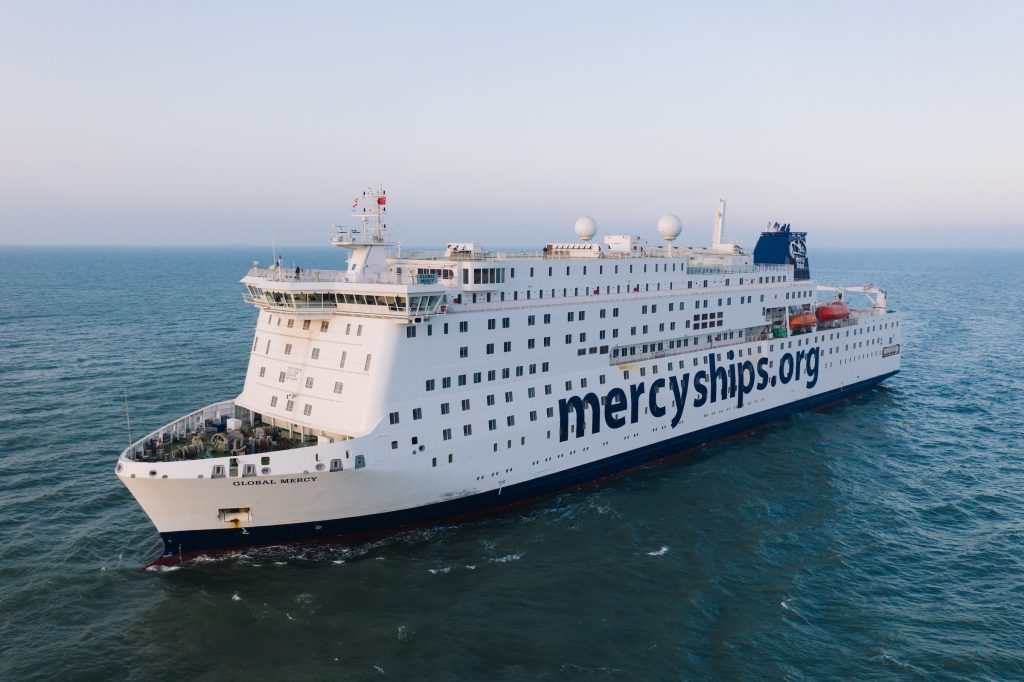
Operating the largest civilian hospital ships in the world, the organisation brings free, life-changing surgical care to some of the most underserved regions, delivering not only surgery, but dignity, hope and long-term impact.
Its hospital ships, most notably the Africa Mercy® and the Global Mercy™, are equipped with state-of-the-art operating theatres, recovery wards, laboratories and training facilities. But what truly defines them is not the technology, it is the purpose behind it.
Each year, these ships dock in countries where access to safe surgery is limited or non-existent. There, a global community of volunteer professionals — surgeons, nurses, anaesthesiologists, engineers and support crew — come together to provide care free of charge.
While surgical intervention is at the heart of Mercy Ships’ work, its mission goes far beyond individual procedures.
Patients treated onboard often suffer from conditions that have gone untreated for years: tumours, cleft lips, severe burns, orthopaedic deformities. For many, access to care is not merely difficult, it is impossible.
The impact of a single surgery is therefore profound. It is not only about restoring health, but about restoring identity, confidence and the possibility of a future.
At the same time, Mercy Ships invests heavily in training local healthcare professionals and strengthening medical systems from within. By sharing knowledge, resources and expertise, the organisation ensures that its impact continues long after the ship leaves port.
Mercy Ships has now performed more than 128,000 surgical procedures and trained over 56,000 healthcare professionals. Yet statistics alone do not explain the emotional power of the mission. For that, one must hear the story of Fifalina.
The Story That Silences the Room
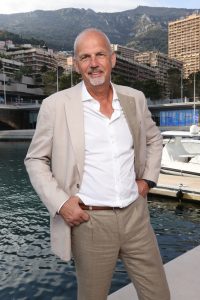
For Roland Brautigam, Mercy Ships’ official Ambassador in Monaco, one patient story stays above all others. Nine-year-old Fifalina.
Through the gift of life-changing surgery for her bowed legs, she became one of thousands of children handed back a new chance at life.
Roland reaches for his phone and pulls up the video.
“During last year’s E-Prix, I made a number of presentations, and also during both our galas. Out of 100 people, when I showed this story, 20 were moved to tears.”
He turns the screen around. A young girl. Before. After. A transformation that words cannot fully carry. The reaction is immediate.
“Your reaction is completely normal,” Roland says gently. “I’ve had grown men standing in front of me and crying. I sometimes cannot even watch it myself.”
Then he pauses.
“But this is only one girl. When the ships arrive in port, there are hundreds of children waiting to be given back their futures. In 2026, we are still necessary.”
The silence that follows says more than any statistic could.
One of the most remarkable aspects of Mercy Ships is its global volunteer network. Crew members onboard, medical and non-medical alike, offer their time and expertise voluntarily. They come from over 70 nations, united by a shared commitment to service. This creates a unique environment where cultures intersect, skills converge and purpose becomes the common language.
In many ways, the ships themselves become microcosms of what the world could be collaborative, compassionate, and driven by something greater than individual gain.
Bringing Mercy Ships to Monaco
In Monaco, a place often associated with luxury and excellence, Mercy Ships represents a different kind of value, one rooted in purpose and impact.
The Principality has long supported humanitarian initiatives, and Mercy Ships has found a meaningful connection here through events, partnerships and awareness campaigns.
These gatherings bring together individuals who understand that true influence is not only measured by success, but by contribution. They also serve as a reminder that even in the most privileged environments, there is a responsibility to look outward.
Roland Brautigam’s journey with Mercy Ships began almost four years ago, with a first cocktail event during the Monaco Yacht Show, followed by a reception with key leaders at the Yacht Club.
“It’s a beautiful journey, both for Mercy Ships and for me personally,” he says. “We could never have imagined the way we would grow Mercy Ships within the Monaco community, raising awareness and funds as we have done so far.”
For Roland, the title of Ambassador carries real weight.
“The title gives me responsibility, and it provides me with motivation to be part of a worldwide team that does nothing but try to make this world a better place for everybody, particularly for people who have very little access to the healthcare they need.”
In Monaco’s highly connected social environment, this responsibility is lived daily.
“When I’m out socialising, it’s very often that I’m approached by people because of this role. And I approach people who I believe can help us further grow the charity within the Principality.”
In 2023, Mercy Ships and Roland began planning a Charity Gala to raise awareness and funds in Monaco. The Principality, with its substantial yachting community and numerous philanthropists and philanthropic organisations, seemed like the perfect next step.
The first Monaco gala was held on June 15, 2024. Guests flew in from various countries, including more than 50 from Switzerland, Italy and France who came solely to participate. The event raised €400,000 in support of Mercy Ships.
For many guests, it was also the first time they truly understood the scale and beauty of the organisation’s mission. Short video clips were shown on large screens to explain the work, including footage of Nelson Mandela promoting Mercy Ships.
Building on this momentum, the second gala elevated both scale and ambition.
Featuring curated silent and live auctions, the event generated donations exceeding €700,000, further strengthening Mercy Ships’ ability to deliver life-changing surgical care where people need it most.
“The biggest lesson we learned,” Roland explains, “was that when we talk about doing something meaningful within the Principality, and reach people who have a philanthropic feeling themselves, we can truly raise awareness and funds for Mercy Ships.”
That concept is simple but powerful: do not allow the evening to become passive.
“We are not just a gala like most galas, where you arrive, have drinks, have dinner, have an auction and go home. We touch both emotions during our events — people get entertained, and people get touched. That is what makes our gala different.”
This philosophy reflects a deeper understanding of Monaco itself. In a place with many prestigious charity evenings, emotional authenticity is essential. Guests must not only attend, they must feel.
The Third Edition: A Night on the Water
The third edition will continue this evolution. This year, the event takes place at the Hall of Champions at Port Hercule, a setting Roland describes as spectacular.
“We are on the water, just like Mercy Ships itself. We will dress it like a beautiful ballroom.”
The theme is football, bringing a dynamic energy to the evening.
“This year, we are in a long venue which gives everybody a proper view of the podium. That is something I found lacking at other galas: you can end up sitting with your back to the stage. We are doing that differently this year.”
For Roland, detail matters.
“The party starts the moment you arrive. I wanted to organise something where you are never left too long without being entertained, and where the auction is compact but raises the maximum for the charity.”
This year, Mercy Ships has also been chosen as a beneficiary of the Barbagiuans’ Pilot Cup match, with Louis Ducruet involved. The connection began at last year’s gala.
“When I did the presentation, Louis Ducruet was in the room together with Rama Goren, the president of the Barbagiuans. They were touched by our story. And they told us that for 2026, they wanted Mercy Ships to become one of the beneficiaries of the Pilot Cup.”
For Mercy Ships, the significance is both financial and symbolic.
“We were of course delighted, not only for the funds generated, but for the tremendous reach this match has, with over 100 million followers worldwide across social media. Locally, it is a huge event. For Mercy Ships to be named as beneficiary was a confirmation of the importance of bringing Mercy Ships into the heart of this Principality.”
Beyond the Barbagiuans, Mercy Ships has also been chosen by the Propeller Club of Monaco as beneficiary of its 50th anniversary gala.
“For us, as part of the shipping community, this is tremendously meaningful, not only for the funds raised, but for the awareness it generates throughout shipping companies and the maritime community in Monaco and beyond.”
Across all editions, Roland insists on one non-negotiable principle: positivity.
“Our message must always be one of positivity. It is such a serious subject, and we want to show the good that is being done by the people who live and work on a ship in the poorest countries on Earth. Positivity, optimism. Negativity and bad energy, we try to stay away from those entirely.”
This is perhaps why the gala resonates so strongly. It does not deny suffering, but it refuses to centre hopelessness. Instead, it shows transformation.
Monaco as a Philanthropic Capital
When asked how he assesses Monaco’s philanthropic landscape, Roland is direct.
“I think Monaco is among the most philanthropic countries in the world. The people who live here and visit our events are very generous — as witnessed by the results of our gala alone.
There are many galas, and almost each one is linked to some charity. It is a very competitive environment. And so it is important to recognise that, despite this, there is still so much generosity here.”
This observation connects directly with Monaco’s broader international reputation as a donor nation. The OECD data confirms what Mercy Ships experiences on the ground: Monaco’s philanthropic strength is not only institutional. It is cultural.
Former UN Secretary-General Ban Ki-moon once famously described Monaco as a “small country with a big heart.” At the time, the phrase sounded poetic. Today, the data increasingly supports it.
Over just two years, Monaco’s international cooperation initiatives reportedly reached approximately 3.5 million people globally. For a nation of fewer than 40,000 residents, that scale of impact is extraordinary.
Monaco’s strength is not only the money it gives. It is the networks it can activate.
The OECD recognition may ultimately represent something larger than development statistics. It signals Monaco’s broader evolution into a new type of microstate, a financially sophisticated, environmentally engaged, and philanthropically influential.
In many ways, Monaco is quietly building a modern model of strategic relevance for small nations in the 21st century. A model where influence no longer depends purely on territory or military power, but on intelligence, diplomacy, sustainability, science, finance and international cooperation.
Mercy Ships embodies this model beautifully. It connects Monaco’s maritime identity with humanitarian impact. It connects wealth with responsibility. It connects gala culture with life-saving surgery. It connects privilege with purpose.
Monaco appears to understand that long-term prestige increasingly depends not only on prosperity, but on purpose. Therefore, the OECD’s recognition of Monaco among the world’s leading donor nations is important not simply because of the numbers involved.
It matters because it reflects a deeper transformation in the Principality’s global role. Monaco is no longer positioning itself solely as a centre of luxury and finance. It is increasingly emerging as a diplomatic actor, an environmental advocate, a scientific supporter, a humanitarian contributor and a strategic voice in global sustainability discussions.
Mercy Ships gives this transformation a deeply human face. At its core, Mercy Ships is about more than medicine.
It is about restoring balance in a world where opportunity is unevenly distributed. It is about recognising that access to healthcare should not be determined by geography or circumstance. And above all, it is about humanity expressed through action.
Long-term Monaco resident Roland Brautigam has brought something genuinely meaningful to the Principality: a moving, emotional and transformational annual event honouring the extraordinary work of Mercy Ships.
In a world often defined by complexity, Monaco and Mercy Ships together offer something profoundly simple: wealth with responsibility, influence with compassion, and hope, delivered quite literally, across the ocean.