Why Ultra-High-Net-Worth Investors Are Quietly Entering the Space Economy
From Monaco to the Moon: The Rise of Lunar Infrastructure and the New Space Economy.
For decades, space belonged almost exclusively to governments. It was the domain of Cold War rivalries, astronauts, national prestige, and symbolic victories broadcast through grainy television screens to an astonished humanity.
Today, something extraordinary is happening. Space is becoming investable. And increasingly, some of the world’s most sophisticated ultra-high-net-worth investors are quietly positioning themselves, not around science-fiction fantasies, but around what many believe could become the next foundational industrial economy.
Because the modern space sector is no longer fundamentally about rockets. It is about infrastructure, and perhaps nowhere is this transformation more visible than in the growing race toward the Moon.
For years, public perception around private space ventures revolved around spectacle: rocket launches, celebrity astronauts, space tourism, and billionaire ambition. This created the illusion that the modern space economy was little more than a luxury experiment for the ultra-rich.
Serious investors increasingly disagree.

Behind the headlines, a far larger industrial transition is unfolding. The most sophisticated capital entering the sector today is no longer chasing novelty. It is positioning itself around the infrastructure layer of humanity’s next economic frontier.
Historically, extraordinary fortunes emerged around infrastructure revolutions such as ports, railways, telecommunications, air travel, oil pipelines, etc. The investors who understood infrastructure early often shaped entire eras of economic power.
Many UHNW investors increasingly view space through this same historical lens. Not as aviation or tourism, but as the emergence of a new industrial geography.
The Moon is increasingly viewed not as a destination, but as a strategic resource and infrastructure platform. This distinction changes everything.
Interestingly, Monaco is beginning to emerge as an increasingly relevant environment for frontier technologies and deep-tech conversations.
Traditionally associated with luxury, finance, yachting, and lifestyle, the Principality is quietly attracting a growing ecosystem of family offices, sustainability-focused investors and strategic capital allocators. This evolution reflects a broader transformation in modern wealth psychology.
At a certain level of success, many investors no longer seek purely financial returns.
They seek intellectual legacy, civilization-scale impact, and meaningful technological transformation. Space uniquely satisfies all three. And this is where companies such as Lunar Exploration Ltd. become increasingly fascinating.
As of today, Monaco does not officially have a globally recognised unicorn startup – meaning a privately held company valued at over $1 billion.
This is precisely why conversations around Lunar Exploration Ltd. are attracting growing attention. The company is not currently a unicorn.
Yet its positioning around: lunar geospatial intelligence, Helium-3 prospecting, resource mapping, mission-planning analytics and future lunar infrastructure, places it directly inside sectors where valuations could become extremely significant if the space economy accelerates over the coming decade.
In many ways, Lunar Exploration represents something larger than a startup. It reflects the emergence of Monaco itself within the frontier innovation conversation.
European Space Agency Recognition
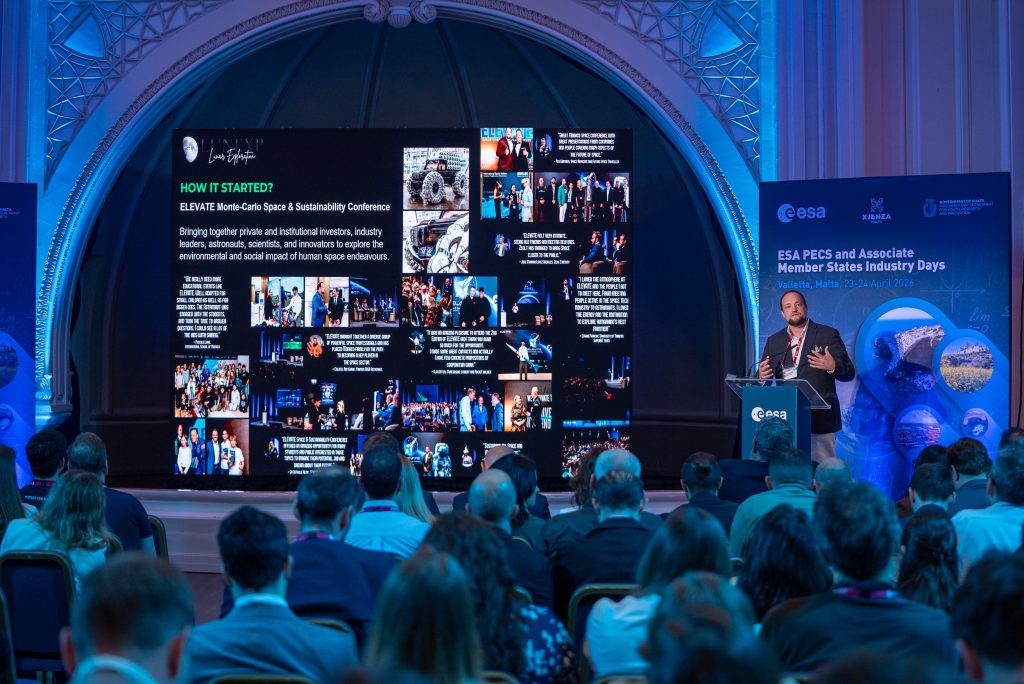
During the ESA PECS & Associate Member States Industry Days 2026 held in Valletta, Malta on 23–24 April 2026, long-term Monaco resident and entrepreneur Zsolt Szemerszky presented Lunar Exploration’s geospatial intelligence platform to European Space Agency stakeholders and institutional partners.
Organised by the Capability and Country Support Division within the European Space Agency’s Directorate of Commercialisation, Industry and Competitiveness, the event focused on strengthening collaboration across Europe’s rapidly evolving space ecosystem.
This recognition matters because the future lunar economy will not depend solely on rockets. It will depend on intelligence.
One of the most misunderstood aspects of the lunar economy is that before any large-scale industrial activity can occur, the Moon must first be understood with extraordinary precision.
Before extraction comes mapping, before infrastructure comes intelligence. This is precisely where Lunar Exploration positions itself strategically.
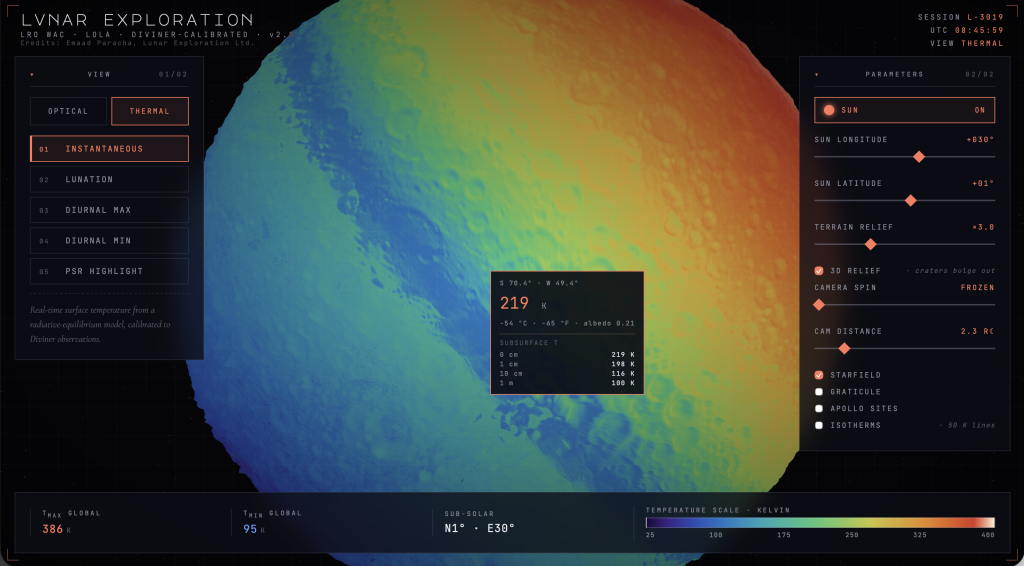
The company is developing what it describes as a commercial-grade digital twin of the Moon:
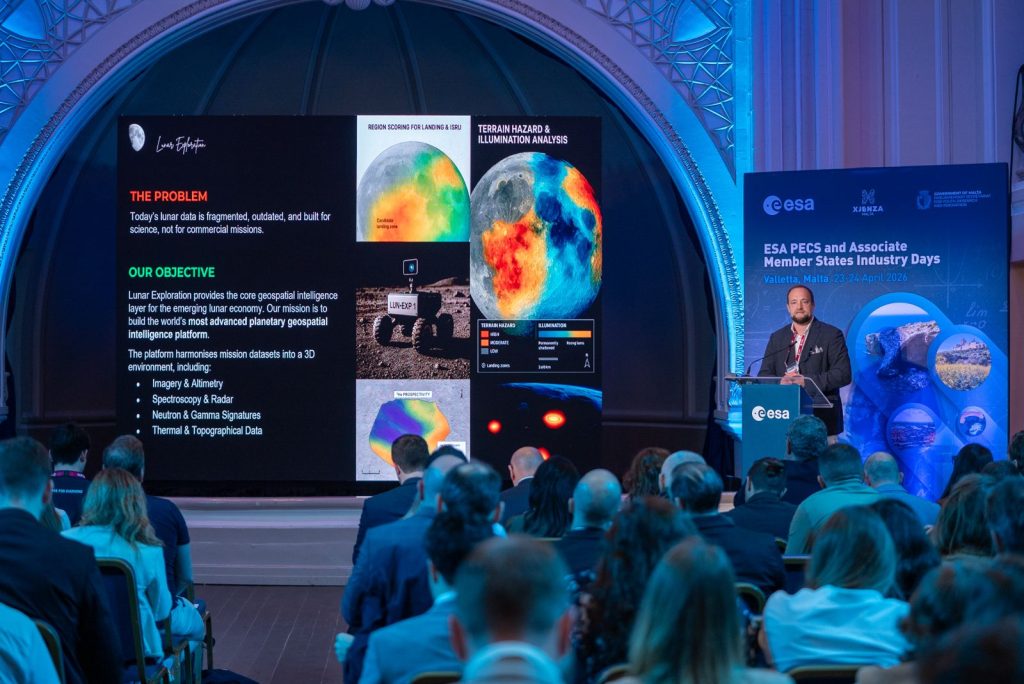
a geospatial intelligence platform designed to provide: high-resolution lunar mapping, terrain analysis, resource probability modelling, illumination mapping, hazard detection, landing-region scoring, and mission-planning analytics.
Its vision is both simple and ambitious: before governments or private operators can sustainably build infrastructure on the Moon, they first require accurate and reliable data.
In many ways, the early lunar economy may resemble the early internet: those controlling the information layer may ultimately become more valuable than those operating the physical infrastructure itself.
The Moon as a “Space Gas Station”
For generations, humanity viewed the Moon primarily as a symbol of exploration.
Today, it is increasingly viewed as something far more strategic: the foundation of a future space economy. At the centre of this transformation lies one critical resource: water.
Scientists, governments, and private companies now consider lunar water one of the most important discoveries for the future of human expansion beyond Earth. Because water in space is not merely water.
It becomes:
- oxygen
- hydrogen
- breathable air
- radiation shielding
- agricultural support
- cooling systems
- rocket fuel
Without local resources, every kilogram required for survival must be transported from Earth at extraordinary cost. With local resource utilisation, the economics of lunar settlement change fundamentally. In practical terms, this transforms the Moon from a destination into infrastructure.
However, the revolutionary aspect of lunar water lies in chemistry.
Water (H2O) can be separated into hydrogen and oxygen – the essential components of rocket propellant. This changes the economics of space travel dramatically.
Lunar water could eventually allow spacecraft to:
- refuel in orbit
- support deep-space missions
- power long-duration lunar operations
- support Mars logistics
- sustain permanent infrastructure beyond Earth
In simple terms: the Moon could become a space gas station. This concept alone is reshaping long-term strategic thinking within both government and private aerospace sectors.
Rather than transporting everything from Earth, future missions would increasingly use local resources directly. This philosophy is known as ISRU (In-Situ Resource Utilization).
Historically, civilizations only scaled sustainably when they learned to utilise local resources efficiently. Space may follow the same pattern, and water is likely to become one of the most valuable strategic resources in that ecosystem.
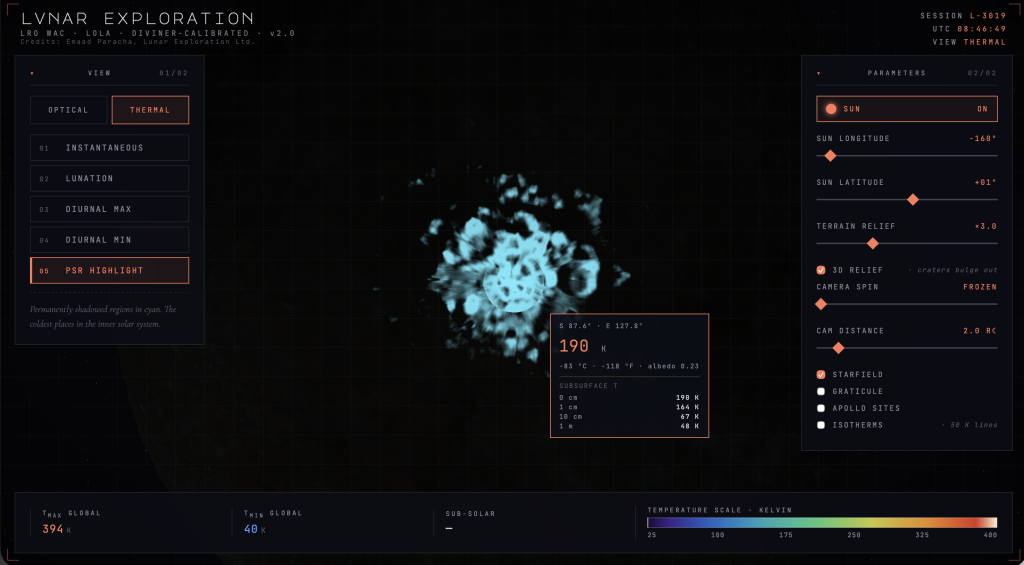
This explains why identifying, mapping, and analysing lunar ice deposits is becoming so critically important.
The $30 Million Question
Among all the resources believed to exist on the Moon, few generate as much fascination as Helium-3. This rare isotope is considered by many scientists and investors to be one of the most strategically important long-term resources in the emerging space economy.
Helium-3 is extremely rare on Earth but believed to exist in far greater quantities within the lunar regolith; the dust and rock covering the Moon’s surface.
Its importance lies primarily in nuclear fusion. Unlike traditional nuclear fission, fusion combines atomic nuclei together, the same process powering the Sun itself.
If commercially viable fusion using Helium-3 becomes achievable in the future, the implications could be extraordinary:
- dramatically lower carbon emissions
- cleaner energy production
- reduced radioactive waste
- greater long-term energy security
- less dependence on fossil fuels
In a world increasingly shaped by climate concerns and geopolitical energy instability, the strategic importance becomes obvious.
And, because Helium-3 is exceptionally rare on Earth, speculative estimates surrounding its theoretical value are enormous.
Some long-term projections suggest values reaching up to $30 million per kilogram, or potentially even higher depending on future fusion economics.
Critics correctly point out that commercial fusion remains technologically unresolved. Yet sophisticated investors increasingly understand something crucial: strategic value does not require immediate monetisation.
Much like rare earth elements before the technology boom, Helium-3 represents long-term optionality. And those who position themselves early around resource intelligence may hold enormous strategic advantages later.
Space Tourism vs Real Industrial Opportunity
One of the most important distinctions sophisticated investors increasingly make is the difference between: space tourism and space industrialisation.
Tourism captures headlines. Infrastructure captures value.
Private astronaut missions are undeniably fascinating. And companies such as SpaceX, Blue Origin, and Virgin Galactic have transformed public perception around access to space. Yet many serious investors view tourism as only a small component of the broader opportunity.
Perhaps the most underappreciated aspect of the modern lunar race is geopolitics. Space is rapidly becoming one of the most strategically important domains on Earth.
Meanwhile, lunar positioning increasingly intersects with technological sovereignty and strategic resource access. And for investors, this geopolitical urgency creates something extremely powerful: long-term inevitability.
There is also something deeply philosophical occurring. For generations, space represented humanity’s collective imagination.
The Apollo missions inspired millions not because they generated profits, but because they expanded human perspective.
The famous Earthrise photograph captured during Apollo 8 fundamentally changed how humanity viewed Earth itself.
Many investors in the modern space economy still speak about this “orbital perspective”, the realisation that Earth is fragile, interconnected, and borderless. This emotional dimension differentiates space from almost every other industry.
Perhaps the most important shift is conceptual. For decades, space was perceived as fantasy. Today, it is becoming infrastructure. And sophisticated investors increasingly recognise that humanity may be standing at the beginning of one of the largest industrial expansions in modern history.
The ultra-high-net-worth investors entering the space economy today are not simply betting on rockets. They are positioning themselves around what they believe could become one of the defining infrastructure transitions of the 21st century.
The Moon is no longer merely a symbol of exploration but perhaps most importantly a long-term extension of human civilization itself.
Companies like Lunar Exploration Ltd. may ultimately play a critical role, not necessarily by planting flags, but by building the intelligence systems that help humanity understand where to go next.